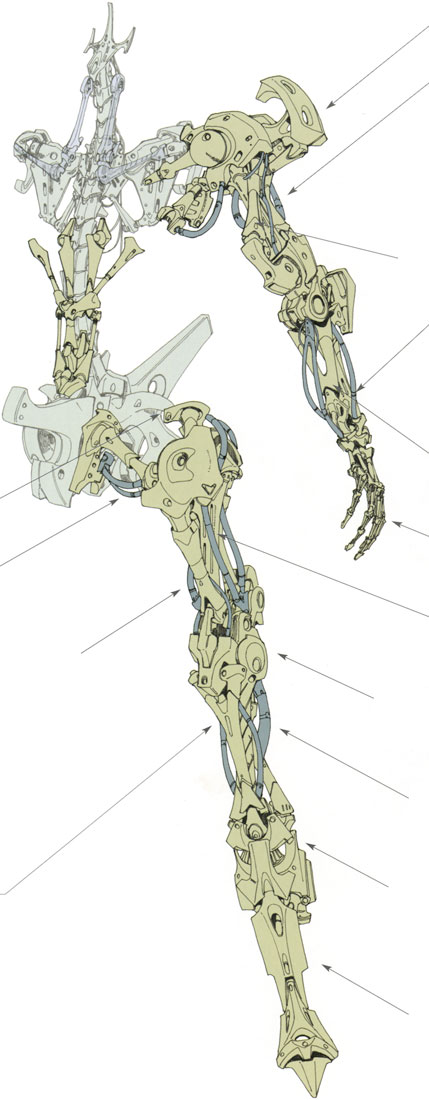
This diagram is distorted for illustrative purposes. The power cylinders are all at full extension. This is for a Siren MH, specifically V Siren, and does not necessarily apply to Arcana Siren, Mirage series, and Mighty series since they use the more complex Piled Counter Tissue rather than standard Power Cylinders.
Support arm for attaching the large shoulder covering.
The explosive strength of the power pistons comes from ezlaser bypasses inside the large upper arm and thigh bones. Located internally to protect them from combat damage, external tubing is only used for the return bypasses (grey-colored parts).
Pushes against the elbow cam to extend the arm.
Bypass for returning energy recovered from the arm to the main engine. Power is transmitted through the shoulder to the keel. While the two return bypasses here on the V Siren Neptune are visible from outside, combat damage to them is not a significant issue as they only carry recovered energy.
The power cylinder responsible for extending the forearm is split and linked on either side of the elbow to allow swinging movement.
Too small to see on this diagram, the wrist and fingers are made from a multitude of power cylinders.
Equivalent to a human’s thigh bone. Incorporates data cables and an energy bypass inside.
While the power cylinders perform the same functions as muscles and tendons on a human, the joint section not only has to bend the joint, but also act correspondingly when bending or extending the leg, and when jumping.
This bypass carries recovered energy from the legs to the engine via the hips and keel.
The calf makes use of the largest X-shaped power cylinder. With a central torsion bar acting as a significant shock absorber, the two combined power cylinders can produce extreme force. The dual cylinder setup allows for free ankle movement and swinging of the leg from the knee.
While not strictly necessary for combat, the heel does relieve some of the burden on the ankle. As such, it is generally included using a standard power cylinder.
Responsible for raising the leg forward, and is a reactive power cylinder for this purpose.
Power cylinder for spreading the legs.
A bidirectional power cylinder is employed on the front of the thigh to reduce the load on the knee and for kicking motions.
For bending down the knee and extending the heel.